Court Records in Kane County can be accessed quickly through the official online portal, where users enter a case number, party name, or filing date to retrieve documents such as complaints, motions, and judgments. The system highlights the status of each case, notes any sealed or juvenile restrictions, and provides direct links to request certified copies from the circuit clerk. By matching docket details with the searchable database, residents save time and avoid common errors that delay obtaining the needed official court documents.
Court Records search results also reveal public case directories, showing recent filings, hearing dates, and final dispositions across civil, criminal, and family courts. When a file appears missing, the portal guides users to submit a court record request for verification, outlining fee structures and typical processing timelines. This transparent approach helps users confirm case history, understand jurisdictional boundaries, and secure accurate copies for legal or personal purposes.
How to Search Court Records
Court Records in Kane County are managed through the Circuit Clerk’s official case-search database. In addition, consulting official kane county records confirms that a case number gives the most direct starting point, and a party name or filing date can help locate a case when the number is unknown. Search results can show case status, scheduled hearing dates, docket activity, and available filed documents. The search helps locate a case record; it does not replace a certified copy for a purpose that requires one.
Official Search Portal: https://cic.countyofkane.org/Pages/Online-Court-Records.aspx
Steps to Search
- Open the official Kane County Circuit Clerk page and follow its online court-records search service.
- Enter the exact case number when you have it. Copy every digit, letter, and suffix from the source instead of retyping from memory.
- If no case number is available, search by the party’s full legal name. Add a filing date or case type when those fields appear in the search form.
- Review each matching case. Compare the party names, filing date, case type, court, judge, and case status before opening a document.
- Open the matching case and select a docket entry or filed document. Follow the official instructions for an ordinary copy or certified copy when the receiving office requires one.
Required Search Details
The most dependable key is the case number copied from a pleading, notice, hearing notice, or prior search result. A party-name search works best with the full legal name, including a middle name or suffix when the case uses one. Business-party searches should use the name shown on the case caption rather than a shortened trade name.
A filing date can narrow results when paired with a party name because many cases may share the same filing day. When the form presents case-type or court fields, use them to remove cases from another division, county, or circuit. Check every returned case for its number, party names, date, type, and court before opening a document.
Case Filings & Proceedings
Kane County circuit records cover civil, criminal, family, probate, and juvenile case activity. Public docket entries can identify filings, hearing events, rulings, judgments, settlements, dismissals, and case status. An entry points to a court event; the filed document supplies the full wording, terms, signatures, and legal effect. Review the document itself before treating a short online label as proof.
Complaints, Petitions & Answer Responses
Complaints and petitions usually present one party’s claims, factual allegations, and requested relief. A criminal matter may begin with a charging document rather than a civil complaint, and family or probate matters may use a petition. An answer or response states the opposing party’s position and may raise defenses, admissions, counterclaims, or agreement to certain issues. These filings establish the parties’ positions, but the allegations are not proof by themselves.
Read the caption, filing date, requested relief, and signature on the filed document. A docket description can shorten the description and omit legal terms that matter to the case. The search result helps you find the filing; the document establishes what was filed and what the party asked the court to do.
Motions, Notices & Filed Exhibits
A motion asks the court to take a specified action, such as allow or deny a request, change a schedule, or resolve a disputed filing. The related order records the ruling. When the docket text differs from the order, use the signed order to determine the court’s decision. Keep the docket date so you can request the correct document if the result shows only a summary.
Notices can announce hearings, filing requirements, scheduled appearances, and other court events. Check the date printed in the notice and compare it with the date shown in the case listing. A notice’s presence in the docket does not by itself prove that a hearing took place or that every listed deadline was met.
Presiding Judge & Courtroom Jurisdiction
Kane County sits within the Illinois 22nd Judicial Circuit. The judge and courtroom fields in a case listing show the assignment recorded for that case. Judges can change, and a case may have activity before different judicial officers at different stages. A name shown beside an older filing may not describe the judge handling the next hearing.
Compare the judge, courtroom, and court shown in the current case details with the hearing notice or most recent order. A courtroom label identifies where an event was scheduled or recorded; it does not decide the court’s legal authority over the case. Venue and jurisdiction come from the court named in the case and the law governing that case, not from the location of an online search.
Hearings, Judgments, Settlements & Dismissals
A scheduled hearing date does not prove that the hearing occurred. After the date passes, look for a minute entry, appearance record, order, or later docket event. If the listing still shows only the scheduled date, the record may not yet contain the later entry. Keep checking by case number, or ask the Circuit Clerk about the status of a specific hearing date.
Settlement records can include a stipulation, agreed judgment, or dismissal document. A party’s statement that a case settled is not the same as a filed settlement record. Review the signed terms, including any payment conditions, release language, deadlines, or dismissal language. A dismissal may close one claim while another part of the case remains open.
A case marked closed often has a dismissal, judgment, or other disposition order entered in the record. The status label alone does not describe the terms or legal scope of that disposition. Read the signed judgment or dismissal document and confirm whether the closure covers the whole case or only part of it.
Public Availability & Official Copies
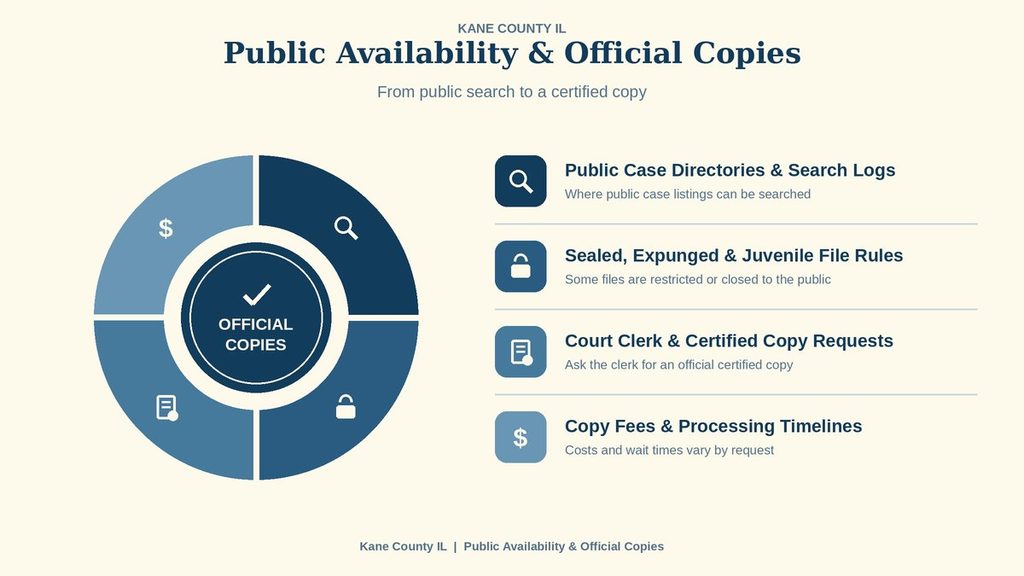
Public availability depends on the record type, court orders, Illinois access rules, and what the Circuit Clerk has indexed. A visible case listing can show public docket activity while leaving some documents unavailable. Treat an online index as a way to locate case material and a certified Clerk copy as the authenticated record when the intended use requires that level of proof.
Public Case Directories & Search Logs
A public case directory is a compact index of cases. It may show a case number, caption, court, judge, filing date, status, and recent events. A search log in this context is the dated sequence of docket entries shown for a case, not the filed papers themselves. Some entries link to an image, while others provide only event text. A returned list shows that the system matched the submitted terms; it does not show that every document in the file is visible.
- Case listing: Provides basic identifiers that help confirm whether the returned matter matches the correct party, court, and case type.
- Docket activity: Lists dated filings, hearings, motions, orders, and other events recorded by the court.
- Document view: May provide an image of a public filing when that document has been indexed for viewing.
- Search results: Show cases that met the submitted terms, but they do not act as a complete paper file or a certification of record accuracy.
Sealed, Expunged & Juvenile File Rules
Sealed records are closed to public view by a court order. The case caption, case number, or a short status line can remain visible while the papers are hidden. A restriction note on the result may show that the Circuit Clerk has flagged the file, but the note does not replace the sealing order or state every condition attached to it. A request by telephone or in person does not remove a seal.
Juvenile records are confidential under 705 ILCS 405/7-701 of the Illinois Juvenile Court Procedure Act, subject to statutory exceptions and court orders. Adoption files and certain police or investigative materials can carry separate limits. Current Illinois Supreme Court rules and case-specific orders also govern exclusions, redactions, and sealing.
The Circuit Clerk can identify a restriction category and explain the process that applies to a particular request. To assist researchers, official criminal court records documentation shows that ask for the case number, the restricted document title, and the date of the related filing. A request for a restricted record is different from a request for a public filing, and the two should not be combined into one unexplained request.
Court Clerk & Certified Copy Requests
The Circuit Clerk serves as the official custodian of Kane County circuit court records. A court record request may be used for a document that is missing from the online view, an older file outside the current index, a bulk set of pages, or a copy that needs certification. The Circuit Clerk can also confirm whether a filing has been entered under a particular case number.
Include the case number, full party name, case type, filing date, document title, and docket date when known. State whether you need an ordinary paper copy, an electronic copy, or a certified copy. Ask for the current charge, delivery method, and expected completion date before placing a large or certified request. These details help staff locate the right file without repeating work.
Copy Fees & Processing Timelines
The Kane County Circuit Clerk sets the current copy and certification charges. The total may depend on the number of pages, whether certification is required, delivery method, and the work needed to locate a file. Do not assume that one amount covers every request type. Ask the Clerk for the current price and which charges apply to your document.
Processing time depends on the request. A single document already shown in the online system may need less work than an older record outside the current index or a large set with many related pages. A certified request also requires a separate verification and completion process. Do not rely on a fixed completion period unless the Clerk provides one for the request.
Record Accuracy & Resolution
A court record is the court’s file for a specific case. A docket entry is the court’s index of events, while a document image is the filed paper itself. A court calendar lists scheduled events but does not prove that a hearing occurred or that the event produced an order. Arrest data comes from police records and may appear in a criminal case as one early step, yet it is not the court case file. “Public records” covers records held by many government offices, so a request for a court file should identify the case number, party, and court.
Accuracy problems often begin with mismatched identifiers. A party name can be entered in a form that differs from the court caption. A case number can contain a prefix or suffix that is easy to omit. A case can also belong to another circuit even when the party has the same name as a Kane County party. Comparing several identifiers gives a stronger result than trusting one field.
Matching Party Names & Docket Numbers
Party-name search depends on the name text stored in the case record. Use the full legal name from the most recent court document, including middle names and suffixes when shown. For a business or organization, use the caption name rather than a shortened operating name. If a case includes several parties, compare the roles shown in the result, such as plaintiff, defendant, petitioner, or respondent.
Copy the case number exactly as printed. Do not remove a prefix, replace a letter with a similar character, or guess a missing digit. The docket number used by a party, lawyer, or other agency may contain a prefix that is not shown in a shortened reference. A copied number preserves that formatting and gives the Clerk the most accurate search key.
System Delays for Recent Filings
New filings pass through clerk intake, case assignment, and data entry before every public view is current. A case filed recently may not appear under the same search terms at once. A hearing date may also pass before the related entry appears. The search system can lag behind activity in the courthouse, so a missing recent result does not by itself mean that the filing was rejected or never entered.
Refresh the search with the same exact identifiers after allowing more time for the entry to be processed. A case number search often gives the cleanest comparison when a name search changes with each new filing. If the matter remains absent, contact the Circuit Clerk with the case number, party name, filing date, and known hearing or document date.
Unlisted Court File Resolution
The Circuit Clerk is the official source for confirming a record that the search does not list. Before contacting the office, check the case number, party spelling, filing date, court, and case type one more time. Note the exact document title and docket date that prompted the search. If the record concerns a deadline, include that date so staff can check the case activity promptly.
Ask whether the filing has been entered, whether the document is available through the online view, and whether a copy request is required. Keep the Circuit Clerk’s response with the case notes. It creates a clear record of what was confirmed and avoids relying on an uncited result from a third-party directory.
Contact Information
Use the Circuit Clerk’s main office for case lookup problems, questions about public file availability, and requests for ordinary or certified copies. Have the case number and party name ready when you call. The office can also confirm whether a filing has been entered or whether a request needs a different case identifier.
Frequently Asked Questions
Finding court records helps you verify case details, track legal progress, and obtain official documents for personal or business needs. Kane County’s online system lets anyone search by case number, party name, or filing date. Results show status, hearing dates, and available files. Use this guide to get the right record quickly and avoid common pitfalls.
How can I search court records in Kane County by case number?
Visit the Circuit Clerk’s case‑search page and enter the full case number in the designated field. Click Search to view the case summary, status, upcoming hearings, and any uploaded documents. If you need a certified copy, note the request button and follow the fee instructions. This method gives the fastest, most accurate match.
What steps let me find court records by party name?
Open the online search tool, choose the “Party Name” option, and type the exact name of the individual or business. Use wildcards if the spelling is uncertain. Review the list of matching cases, then click the desired case to see details such as filing date, docket activity, and downloadable files. Request a certified copy if the case requires official proof.
Can I locate public court records online for civil or family cases?
Yes. The Kane County database includes civil, family, probate, and juvenile records that are not sealed. After entering your search criteria, filter results by case type to narrow the list. Public entries show motions, orders, and judgments. sealed or restricted files will appear as unavailable, and you must contact the clerk for further instructions.
Why does a court record search return “no results” and how can I fix it?
Common reasons include an incorrect case number, misspelled party name, or using the wrong court jurisdiction. Double‑check the spelling, verify the county, and ensure the case is not older than the system’s retention period. If the case still does not appear, call the Circuit Clerk at 630‑232‑3413 for assistance or request a manual search.
What fees apply when requesting certified copies of court documents?
Fees vary by document type and page count. Typical charges range from $2 per page for simple filings to $10 for certified judgments. After locating the record online, click the “Request Certified Copy” link, enter payment information, and submit the form. Processing usually takes 3‑5 business days unless the record requires extra verification.